
Rhubarb and Custard: kleur en teelt
A large-flowered gladiolus in the RHS selection.
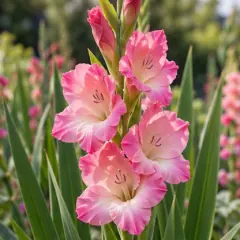
This is a species image. The colour and flower form of this variety may differ.
- Use
- This selection is for ornamental and cut flowers, with no claims about edibility or flavour.
- Care
- Plant corms in a sunny position with well-drained soil. For large summer hybrids, RHS gives a depth of around 10–15 cm. Plant in several spring rounds if you do not want everything flowering at once. Water during dry growing periods and provide support in windy spots.
- Harvest and flowering
- Cut flower spikes for the vase as the lower flowers start to open and leave foliage on the plant so the corm can recover. Keep cultivars or types separate when lifting. Small cormlets can be grown on separately; they do not immediately guarantee a large flowering plant.
What makes Rhubarb and Custard special?
Scent, flavour and use
This selection is for ornamental and cut flowers, with no claims about edibility or flavour.
This describes the species' uses. Check the specific characteristics of your selection.This selection is for ornamental and cut flowers, with no claims about edibility or flavour.
Growing and harvesting this variety
Plant corms in a sunny position with well-drained soil. For large summer hybrids, RHS gives a depth of around 10–15 cm. Plant in several spring rounds if you do not want everything flowering at once. Water during dry growing periods and provide support in windy spots.
Cut flower spikes for the vase as the lower flowers start to open and leave foliage on the plant so the corm can recover. Keep cultivars or types separate when lifting. Small cormlets can be grown on separately; they do not immediately guarantee a large flowering plant.
Choose your way to grow

This image was created with AI from described plant characteristics and growing advice. It shows a possible situation and is not a photograph of a verified cultivar.

This image was created with AI from described plant characteristics and growing advice. It shows a possible situation and is not a photograph of a verified cultivar.
Gladioli in a cutting row
A row keeps spacing, support and lifting manageable.
- Plant large summer hybrids in several spring rounds.
- Install support netting or stakes early.
- Harvest cobs while retaining leaves.
For cut flowers and planned harvesting.
Byzantine gladiolus in a perennial border
A hardier botanical type suits a permanent, sunny strip.
- Choose Gladiolus communis subsp. byzantinus.
- Plant in sun in well-drained soil.
- Let leaves die back after flowering and mark the position.
For a more informal, recurring flower display.
Three very different flower spikes
Grandiflorus hybrids give large flowers on sturdy spikes. Gladiolus communis subsp. byzantinus is a hardier botanical choice for looser borders. Gladiolus murielae, also sold as acidanthera, gives different white/dark markings. These are type/species choices; unlabelled colour bags get no invented identities.
Spread the bouquet season
Split purchased corms into small batches and note planting dates. Label planted patches. One round is easy but may give a short flower peak. Successive spring plantings spread cutting; weather still matters, so expect no exact flowering day per corm.
Support for a narrow plant
Netting above a cutting row helps flower spikes grow upright; in a border you can use individual canes. Do not pull a flower spike tightly against a cane. It needs to grow and move a little. Install supports while you can still see where the corms are, so you do not damage them.
A label accompanies the stored crop
Label each tuber batch when lifting. White, pink and red flowers are no longer recognisable on winter tables. Keep only healthy, dry stock and inspect regularly. Give hardier botanical types separate cards to avoid automatically treating them like summer hybrids.
Scent, flavour and use
This selection is for ornamental and cut flowers, with no claims about edibility or flavour.
Care, cutting and harvesting
Plant corms in a sunny position with well-drained soil. For large summer hybrids, RHS gives a depth of around 10–15 cm. Plant in several spring rounds if you do not want everything flowering at once. Water during dry growing periods and provide support in windy spots.
Gladioli are not pinched out like branching annuals. Let healthy leaves build reserves after flowering and yellow naturally. Lift insufficiently hardy summer hybrids in autumn and store dry and frost-free. Byzantine gladioli can remain in the ground in suitable, well-drained locations.
Cut flower spikes for the vase as the lower flowers start to open and leave foliage on the plant so the corm can recover. Keep cultivars or types separate when lifting. Small cormlets can be grown on separately; they do not immediately guarantee a large flowering plant.
Cutting, caring and following the season
Gladioli are not pinched out like branching annuals. Let healthy leaves build reserves after flowering and yellow naturally. Lift insufficiently hardy summer hybrids in autumn and store dry and frost-free. Byzantine gladioli can remain in the ground in suitable, well-drained locations.
Species information and annual cycle
- Space
- Plant spacing guidance: 10 cm–15 cm. Row spacing is unconfirmed; this is not a complete planting grid. Large corms of large-flowered summer hybrids: space at a similar distance to the stated planting depth of 10–15 cm. Smaller species and container growing differ. No row spacing or mature planting grid has been inferred.
- Soil
- No pH range supported by sources is included. Test your soil and follow species and variety guidance.
- Season
- An indicative growth estimate is included; actual development still needs checking.
- Care
- 2 species care checks included. This is not a complete list of all possible care.
What you need
Tick what you already have. The extras depend on how you grow.
0 of 6 ticked off
Your ticks are saved in this browser.
Make it your garden
Save your favourite variety or add it to My garden. Your own observations determine the growth stage; care tasks are based on the species.
Add Rhubarb and Custard to my gardenExplore more flowersSources and image information
SeedSteps editorial team · checked on 13 October 2026. Flavour descriptions come from the listed sources; ripeness and growing conditions affect flavour. AI images illustrate described characteristics and do not prove cultivar identity.
- World Checklist of Vascular Plants — 4 juni 2026Royal Botanic Gardens, Kew · 2026-10-07
- RHS Recommended: Award of Garden Merit ornamental plantsRoyal Horticultural Society · 2026-10-22
- Cut flowers: growing and selectionRoyal Horticultural Society · 2026-10-13
- How to grow gladioliRoyal Horticultural Society · 2026-10-13
- Gladiolus byzantinusLarch Cottage Nurseries · 2026-10-13
- Gladiolus cultivationNC State Extension · 2026-10-13
- Gladiolus murielae cultivationUniversity of Wisconsin Extension · 2026-10-13