
Kansas: kleur en teelt
Double flowers in deep pink, purple and red shades.
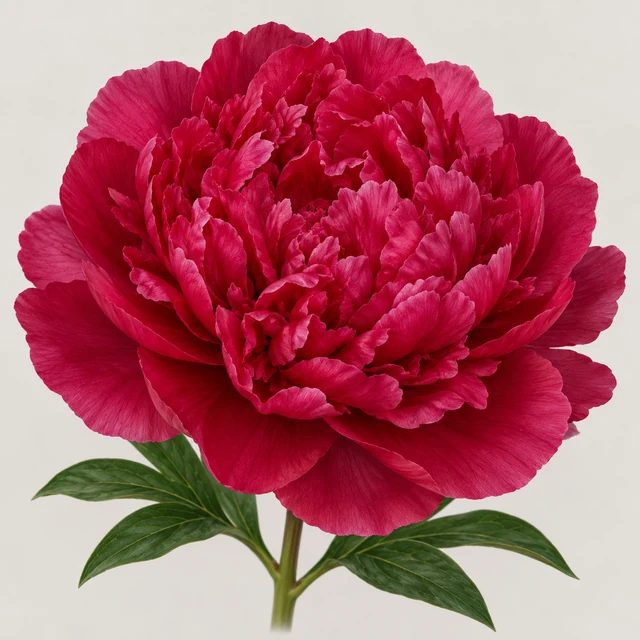
AI cultivar illustration based on described variety traits; not a real cultivar photograph or proof of identity. Flower colour and form vary with flowering stage and conditions.
- Lifespan
- Herbaceous perennial; the above-ground stems die back in winter.
- Position
- Sun and fertile, well-drained soil.
- Flowering
- Late spring and early summer; the variety and actual season determine the timing.
What makes Kansas special?
Scent, flavour and use
These peonies are offered as ornamental and cut flowers. No edibility or flavour difference between varieties is claimed.
This describes the species' uses. Check the specific characteristics of your selection.These peonies are offered as ornamental and cut flowers. No edibility or flavour difference between varieties is claimed.
Growing and harvesting this variety
Choose a sunny spot with fertile, well-drained soil and enough permanent space. Do not plant too deeply: the red growth buds of a herbaceous peony should sit just below the surface. Watch a new plant during dry spells and support heavy flowers before the stems flop.
Peony is treated here as an ornamental and cut flower. Cut only a few stems for the vase from a well-established plant, leaving plenty of healthy foliage. A new planting may not flower abundantly yet; assess the actual buds and flowers rather than the calendar alone.
Choose your way to grow
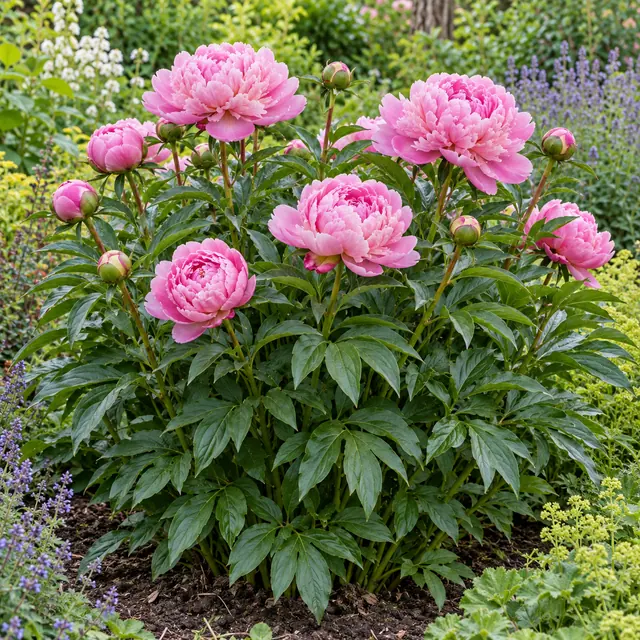
This image was created with AI from described plant characteristics and growing advice. It shows a possible situation and is not a photograph of a verified cultivar.
This image was created with AI from described plant characteristics and growing advice. It shows a possible situation and is not a photograph of a verified cultivar.
A permanent spot in the border
Give a peony permanent space without planting it too deeply.
- Choose a sunny spot with good drainage.
- Plant at the same depth as in the pot; do not cover growth buds with a thick layer of soil.
- Water after planting and monitor establishment during dry spells.
A permanent spot in the garden, with room for the mature variety.
A small cutting patch with support
Support heavy flowers and leave enough foliage on the plant.
- Put suitable support in place before stems bend.
- Cut a few usable flower stems from an established plant.
- Let the remaining healthy stems and leaves keep growing.
A sunny border or cutting strip that is easy to reach.
Choosing a variety
Notice the difference between open and double flowers. Jan van Leeuwen has white flowers with a yellow centre; Sarah Bernhardt produces double pink flowers. Images for the new varieties are clearly labelled species illustrations and do not prove variety colour or flower form.
Do not plant too deeply
Choose a sunny spot with fertile, well-drained soil and enough permanent space. Do not plant too deeply: the red growth buds of a herbaceous peony should sit just below the surface. Watch a new plant during dry spells and support heavy flowers before the stems flop.
Follow the plant through the season
A herbaceous peony remains a perennial after flowering has finished. Let the foliage keep working after flowering. The stems die back in autumn and the plant emerges again the following spring. The app uses your observations; a calendar date does not prove flowering.
Cut flowers and keep the plant
Peony is treated here as an ornamental and cut flower. Cut only a few stems for the vase from a well-established plant, leaving plenty of healthy foliage. A new planting may not flower abundantly yet; assess the actual buds and flowers rather than the calendar alone.
Remove spent flowers if you do not want seeds to form. Leave healthy foliage until it dies back in autumn, then cut the dead stems back low. This applies to herbaceous peonies; do not give tree peonies the same pruning treatment.
Cutting, caring and following the season
Remove spent flowers if you do not want seeds to form. Leave healthy foliage until it dies back in autumn, then cut the dead stems back low. This applies to herbaceous peonies; do not give tree peonies the same pruning treatment.
Species information and annual cycle
- Space
- Recommended spacing is missing. Check the plant label or seed packet; unknown space does not count as free space.
- Soil
- No pH range supported by sources is included. Test your soil and follow species and variety guidance.
- Season
- An annual cycle supported by sources is included; variety, age and location may cause differences.
- Care
- 2 species care checks included. This is not a complete list of all possible care.
Herbaceous perennial in a temperate climate: flowering May · Jun, dieback Oct · Nov, dormancy Dec · Jan · Feb. Outside these periods, shoots emerge or foliage grows. In the southern hemisphere this shifts by six months; unknown and tropical locations do not receive an automatic annual cycle. A young plant is not guaranteed to flower. Herbaceous and intersectional garden peonies; not woody tree peonies. An editorial interpretation of temperate northern seasons. Dormancy after dieback does not mean the roots are dead; assess the actual foliage and buds. Young divided plants are not guaranteed to flower. Spacing of about 1 m depends on final size and is not stored as an exact planting grid.
What you need
Tick what you already have. The extras depend on how you grow.
0 of 6 ticked off
Your ticks are saved in this browser.
Make it your garden
Save your favourite variety or add it to My garden. Your own observations determine the growth stage; care tasks are based on the species.
Add Kansas to my gardenExplore more flowersSources and image information
SeedSteps editorial team · checked on 13 October 2026. Flavour descriptions come from the listed sources; ripeness and growing conditions affect flavour. AI images illustrate described characteristics and do not prove cultivar identity.
- Paeonia lactiflora Pall. — Plants of the World OnlineRoyal Botanic Gardens, Kew · 2026-10-22
- Primrose Hall Peonies cataloguePrimrose Hall Peonies · 2026-10-22
- RHS Recommended: Award of Garden Merit ornamental plantsRoyal Horticultural Society · 2026-10-22
- How to grow herbaceous and intersectional peoniesRoyal Horticultural Society · 2026-10-22