
Chicory: summer roots, winter chicons
Chicory is a crop in two chapters. A strong taproot grows first in the outdoor bed; then a pale head develops on that root in darkness. You can force it in a covered container without covering soil, or traditionally with covering soil, provided the variety suits that method.
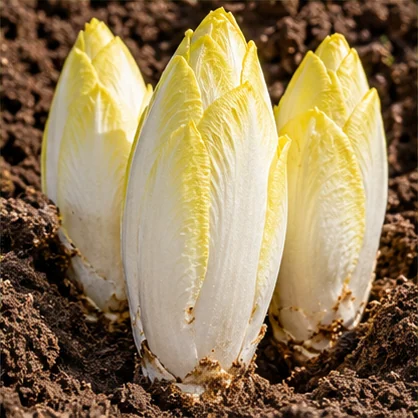
This image was created with AI from described plant characteristics and growing advice. It shows a possible situation and is not a photograph of a verified cultivar.
- First phase
- Raise taproots outdoors from suitable forcing chicory seed
- Second phase
- Force roots upright in complete darkness
- Forcing temperature
- For many crops approximately 10–15 °C; follow variety or root supplier guidance
- Method
- With or without covering soil is a variety choice, not an arbitrary substitution
This growing advice helps you choose. Your variety, growth stage, weather and conditions in your space determine the actual timing.
Sowing under cover and raising seedlings
Sow directly · Chicory
May–June, depending on type and cultivarSow directly for the root crop. Force suitable chicory roots separately in darkness only later.
- Germination and temperature
- Wait for workable, warmed soil; follow the cultivar’s minimum sowing temperature.
- After emergence
- Keep the seed row evenly moist during emergence and identifiable with a label.
- Pricking out and potting on
- Do not prick out. Thin in place; transplanting can damage the taproot.
- Hardening off and planting out
- Stays where sown; hardening off and planting out are unnecessary for direct sowing.
Sow directly for root production. Forcing chicory in darkness later is a separate stage; seedlings are raised in light.
Sources and use
RHS · witlof en cichorei ↗Britse teeltrichtlijn voor een gematigd klimaat; de genoemde perioden zijn richtlijnen voor Nederland en Vlaanderen.
De Bolster · Witlof telen: onze tips ↗Nederlandse producent of teeltbron; de rasinstructie blijft leidend.
De Bolster · Witlof: trekken met en zonder dekgrond ↗Nederlandse producent of teeltbron; de rasinstructie blijft leidend.
Guideline periods for the Netherlands and Flanders. Check the variety, available light, soil and measured temperatures. Greenhouse heating does not guarantee enough winter light.
A different flavour, a different harvest.
Choose by more than the name. Discover how these varieties and crop types taste, what you can use them for and what growing them involves.
2 of 2 choices · 1 named varieties
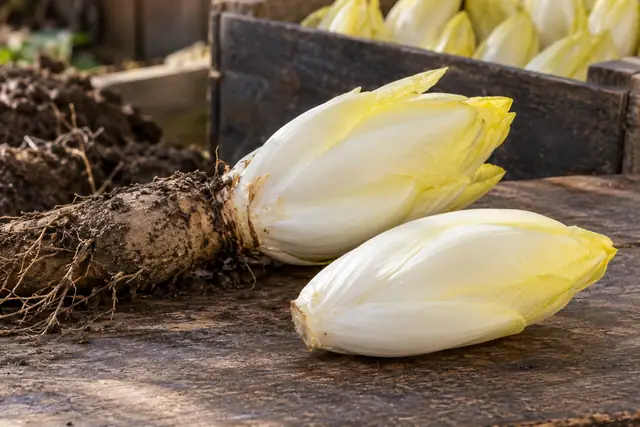
This image was created with AI from described plant characteristics and growing advice. It shows a possible situation and is not a photograph of a verified cultivar.
Hollandse middelvroege
Hollandse middelvroege is a named forcing chicory selection for forcing with or without covering soil. Growing consists of a root stage and a forcing stage.
Choose this variety if you want to follow the two growing stages and try forcing. A short forcing period is not the total growing time.
Flavour, kitchen and growing
How does it taste?
Chicory bitterness is general crop information. The source establishes no distinctive aroma for Hollandse middelvroege.
This flavour description applies to the crop; there is no separate tasting result for this variety.In the kitchen
Use the pale heads raw as salad leaves, or cook whole or halved heads. Healthy heads provide compact portions.
A space in the garden
Grow roots in soil first, then force suitable roots in darkness. Follow product advice for the covering-soil method.
Harvesting
Harvest closed heads after forcing. Assess compactness and colour; harvesting roots does not yet give ready-to-eat chicons.
Read the source notes →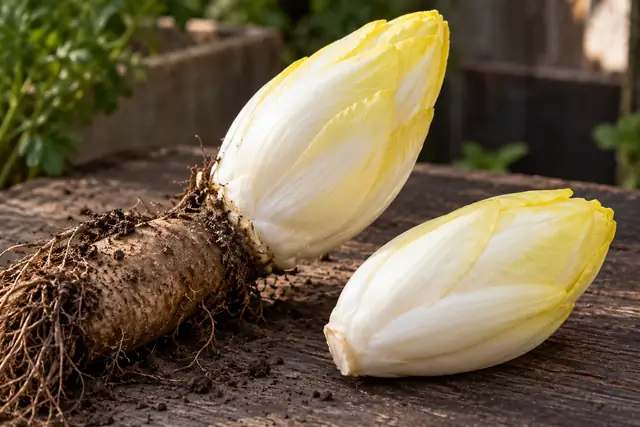
This image was created with AI from described plant characteristics and growing advice. It shows a possible situation and is not a photograph of a verified cultivar.
Brusselse witlof/cichorei
This offering describes Brussels witloof without a further cultivar name. Compact pale heads form after separate root cultivation and forcing.
Choose this type to try general forcing chicory cultivation. Hollandse middelvroege is available separately as a named selection.
Flavour, kitchen and growing
How does it taste?
The source describes a delicate flavour; bitterness is part of chicory as a crop. The listing does not establish a separate cultivar with its own aroma.
This flavour description applies to the crop; there is no separate tasting result for this variety.In the kitchen
Use firm leaves as little salad cups or cook the whole head. The compact harvested part is easy to divide into portions.
A space in the garden
Keep the root-growing and forcing stages separate in your schedule. Forcing in darkness is needed for pale heads, whichever covering-soil method you choose.
Harvesting
Harvest developed, closed heads and check for discolouration from light. A stated few weeks refers to forcing, not the full growing period.
Also listed as: Brusselse witlof.
Read the source notes →Choose your way to grow
From a garden bed to a suitable pot or support: give your plant a place that suits your garden and the care you can provide.
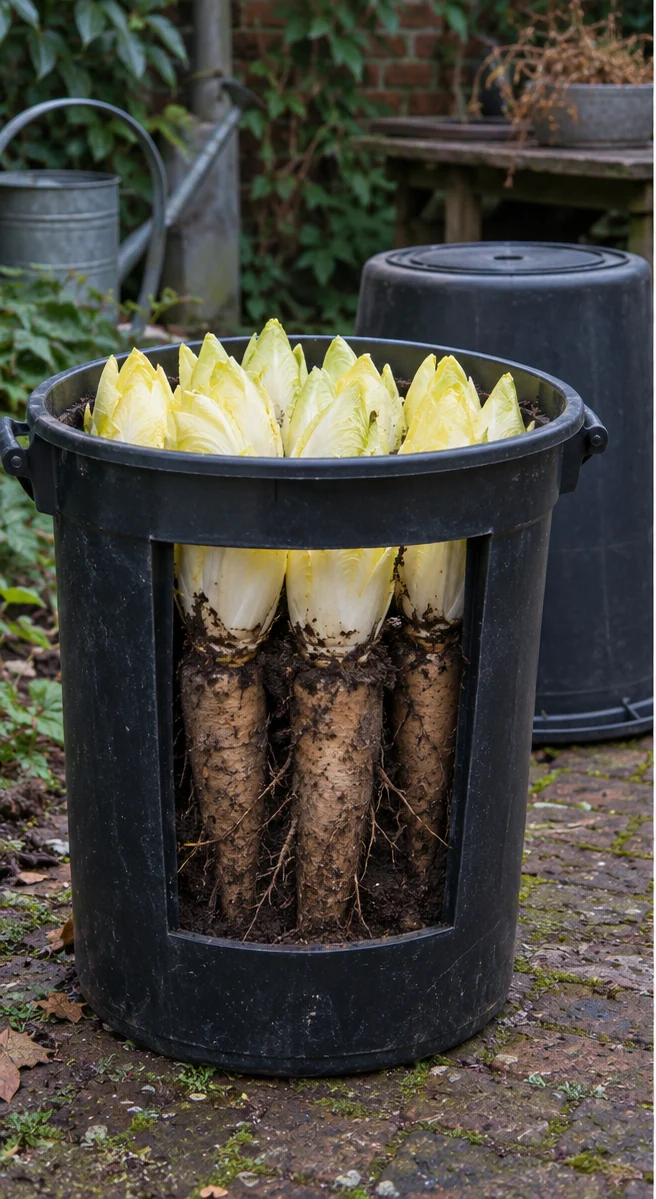
This image was created with AI from described plant characteristics and growing advice. It shows a possible situation and is not a photograph of a verified cultivar.
Forcing without covering soil in a dark bucket
For a variety that can be forced without covering soil, an opaque cover keeps the new head pale. The root crown remains intact.
- Grow sturdy roots first or start with healthy roots suitable for forcing.
- Cut foliage a few centimetres above the crown without removing the growing point.
- Stand roots upright in lightly moist substrate with crowns near the surface.
- Cover completely dark, maintain moderate temperature and check moisture and rot.
For varieties and roots explicitly suitable for forcing without covering soil.
Tick off your supplies →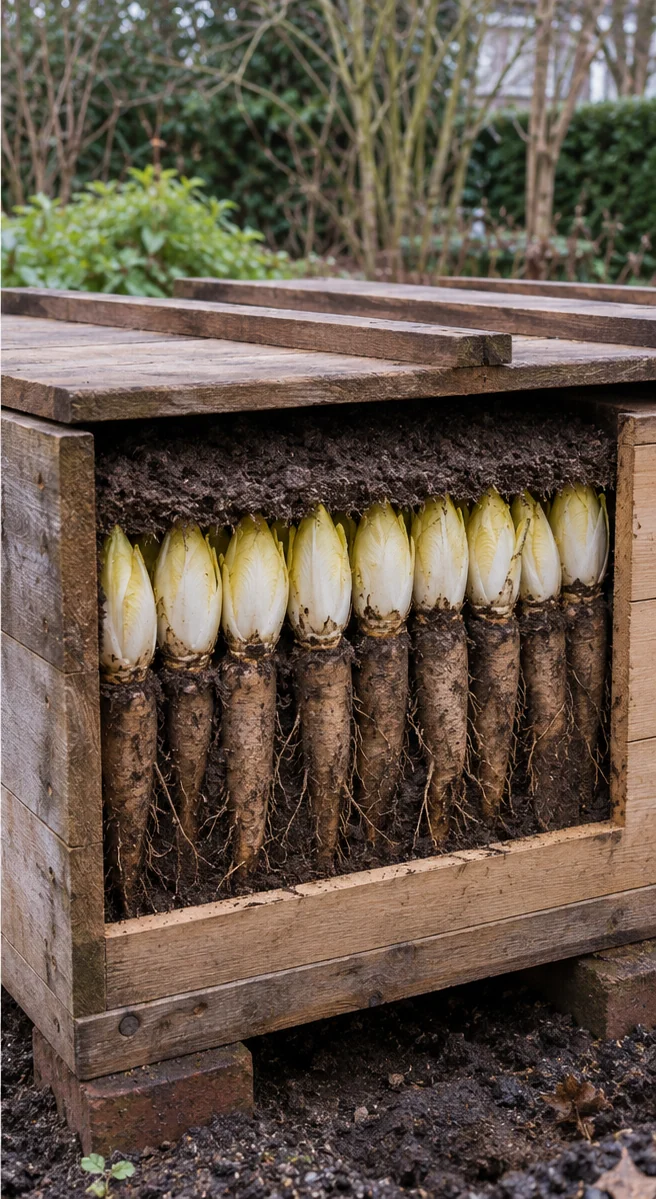
This image was created with AI from described plant characteristics and growing advice. It shows a possible situation and is not a photograph of a verified cultivar.
A traditional forcing box with covering soil
Suitable varieties form the chicon beneath covering soil. This needs a deep container and correct variety instructions.
- Select healthy roots of a variety for forcing with covering soil.
- Stand roots upright close together in a sufficiently deep container with moist substrate.
- Apply the recommended layer of covering soil above the crowns without damaging roots or growing points.
- Keep moisture and temperature suitable and uncover the covering soil gently at harvest.
For deliberate traditional cultivation with a suitable variety and sufficient container depth.
Tick off your supplies →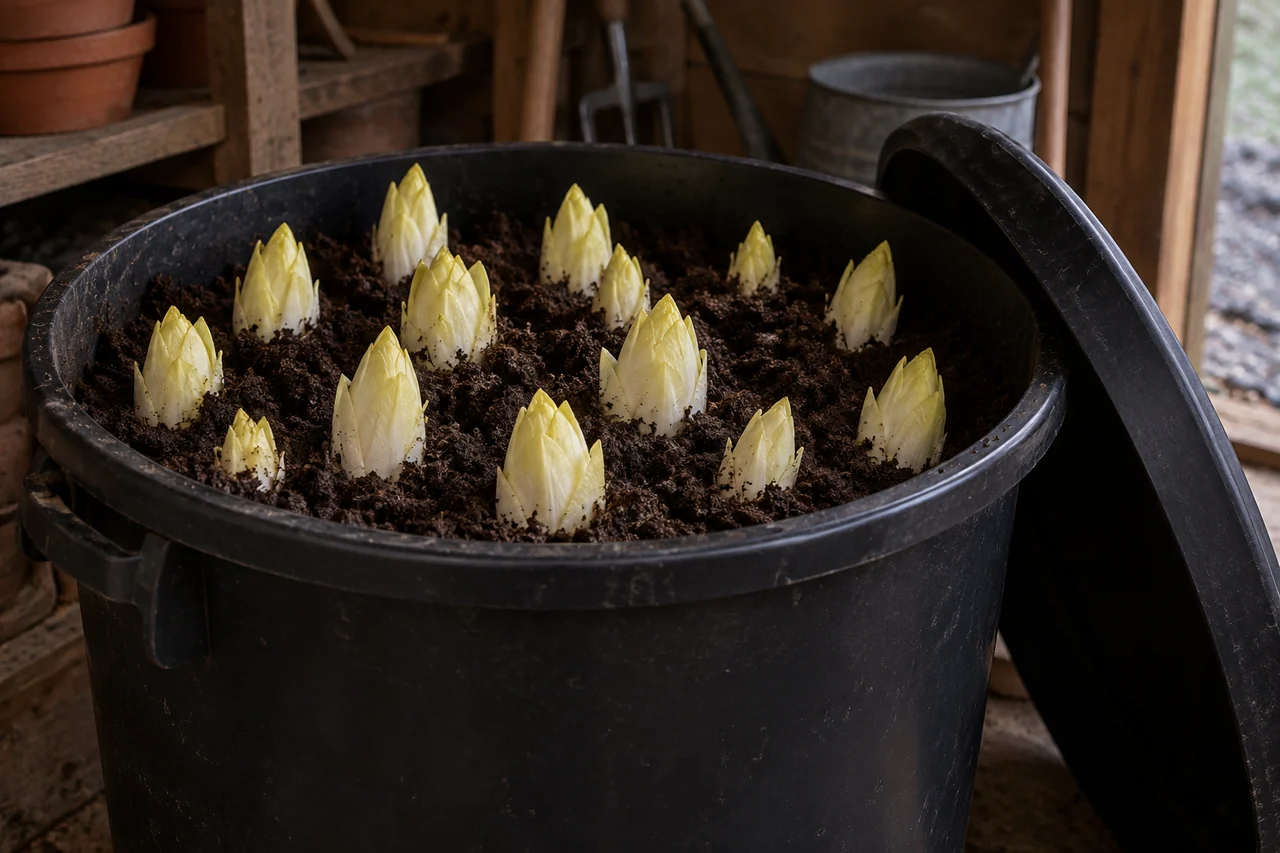
This image was created with AI from described plant characteristics and growing advice. It shows a possible situation and is not a photograph of a verified cultivar.
Roots close together, then complete darkness
Stand the roots upright and fill around them up to the crowns. A completely dark place helps the new heads stay pale.
View your supplies →Explore the varieties
See the confirmed differences. Characteristics without supporting evidence are left blank.
0 of 0 varieties
No matching variety found. Try another name or clear the filters.
Choose two to four varieties to compare their source data side by side.
Choose by flavour, shape and use
Hollandse middelvroege: Hollandse middelvroege is a named forcing chicory selection for forcing with or without covering soil. Growing consists of a root stage and a forcing stage. Use the pale heads raw as salad leaves, or cook whole or halved heads. Healthy heads provide compact portions.
Chicory bitterness is general crop information. The source establishes no distinctive aroma for Hollandse middelvroege.
Brussels forcing chicory: This offering describes Brussels chicory without a further variety name. Compact pale heads follow separate root growing and forcing. Use firm leaves as little salad cups or cook the whole head. The compact harvested part is easy to divide into portions.
The source describes a delicate flavour; bitterness is part of chicory as a crop. The listing does not establish a separate cultivar with its own aroma.
A leaf bed is not yet a forced chicon
Green summer leaves feed the root. The familiar white head is new forced growth with light excluded. Sow suitable forcing chicory; random chicory or radicchio does not automatically give the same compact head in a dark bucket.
Start outdoors with a straight taproot
Sow directly in a fine, deeply loosened bed. May is a useful starting point for many Dutch forcing-chicory crops; follow variety and weather advice. Direct sowing avoids disturbing taproots. Keep the surface moist until plants root sufficiently.
Thick roots need space
Thin promptly following variety guidance so plants do not remain a dense grass-like edge. For general outdoor growing, De Bolster gives about 12 cm within rows and 35 cm between rows. Guidelines, not guarantees for every variety or soil.
Let the root build reserves steadily
Weed shallowly and maintain even moisture during drought. Do not apply nitrogen on a guess; excessive weak leaf growth is not the aim. Let healthy leaves function. If plants fail, check drainage and root quality too: rotten roots are unsuitable for forcing later.
Lift the root with the crown intact
In autumn, loosen soil widely beside the plant. Lift the taproot as intact as possible and select firm, healthy roots. Trim leaves above the crown, leaving the growing point intact. Follow dormancy or cold-storage advice before forcing.
Give roots their own dark growing space
Force a small batch and store other roots cool following appropriate instructions. Stand selected roots upright, not flat, in slightly moist substrate. Choose covering soil or dark covering by variety; simply upturning a bucket is no variety choice.
Darkness and moderate warmth keep growth manageable
For many forcing crops, around 10–15 °C is useful. Warm living rooms can produce fast, loose growth. Measure rather than guess and follow variety or supplier advice. Light greens growth and may increase bitterness; covering must be truly opaque.
Check without flooding the container
Keep substrate slightly moist without persistent mud around roots. Inspect the batch briefly for rot and remove affected roots. Poor roots, damaged growing points or wrong temperatures produce loose or failed heads. Extra feed cannot restore a broken crown.
A closed chicon is the reward
Harvest once heads are compact and usable. Forcing without covering soil commonly takes a few weeks; temperature and root reserves determine timing. Cut or break at the crown and store cool and dark. Do not count a second forcing as an equal full harvest.
What you need
Tick what you already have. The extras depend on how you grow.
0 of 7 ticked off
Your ticks are saved in this browser.
Discover and grow more
More background, sources and image information
SeedSteps editorial team · updated on 11 October 2026. The AI images illustrate species and practical growing situations; they do not prove an exact cultivar, observations from your own garden or yield.
Britse gewasadviezen worden gecombineerd met Nederlandse en Vlaamse informatie waar beschikbaar. Amerikaanse Extension-bronnen ondersteunen plantprincipes en herkenning; hun kalenderdata, lokale plaagdruk, bestrijdingsmiddelen en mestdoseringen worden niet rechtstreeks op Nederland of Vlaanderen toegepast. Vorst, bodemwarmte, standplaats en expliciete rasinformatie blijven de lokale controle. Commerciële bronnen onderbouwen uitsluitend benoemde ras- en plantkenmerken; zij zijn geen affiliate-aanbeveling.
- World Checklist of Vascular Plants — 4 juni 2026Royal Botanic Gardens, Kew · accessed 2026-10-07
- Brusselse witlof cichorei Hollandse middelvroege zaden biologischFeggies · accessed 2026-10-11
- Brusselse Witlof Cichorei zaden biologischFeggies · accessed 2026-10-11
- Chicory: growing guideRoyal Horticultural Society · accessed 2026-10-11
- Witlof telen: onze tipsDe Bolster · accessed 2026-10-10
- Witlof: trekken met en zonder dekgrondDe Bolster · accessed 2026-10-10
- RHS — cichorei kwekenRoyal Horticultural Society · accessed 2026-10-10
- USU Extension — cichorei in de tuinUtah State University Extension · accessed 2026-10-10
Supporting evidence by chapter: Choose by flavour, shape and use: Feggies, Royal Horticultural Society, Feggies. A leaf bed is not yet a forced chicon: Royal Horticultural Society, Utah State University Extension, De Bolster, De Bolster. Start outdoors with a straight taproot: Royal Horticultural Society, Utah State University Extension, De Bolster, De Bolster. Thick roots need space: Royal Horticultural Society, Utah State University Extension, De Bolster, De Bolster. Let the root build reserves steadily: Royal Horticultural Society, Utah State University Extension, De Bolster, De Bolster. Lift the root with the crown intact: Royal Horticultural Society, Utah State University Extension, De Bolster, De Bolster. Give roots their own dark growing space: Royal Horticultural Society, Utah State University Extension, De Bolster, De Bolster. Darkness and moderate warmth keep growth manageable: Royal Horticultural Society, Utah State University Extension, De Bolster, De Bolster. Check without flooding the container: Royal Horticultural Society, Utah State University Extension, De Bolster, De Bolster. A closed chicon is the reward: Royal Horticultural Society, Utah State University Extension, De Bolster, De Bolster.